 admin
admin How to Control Watering Frequency for Soil-Cultivated Snake Plant Cuttings
You’ve carefully placed your snake plant cutting into fresh soil, full of hope for new roots and growth. Yet, the most common question arises: “How often should I water this?” Overwatering is the single biggest threat to your fledgling snake plant, often leading to mushy stems and root rot before it even has a chance to establish itself. Mastering the watering frequency for soil-cultivated snake plant cuttings is not about a fixed schedule; it’s about understanding and responding to the plant’s needs and its environment. This guide will equip you with the knowledge to navigate this critical phase confidently, ensuring your cuttings develop into resilient, thriving plants.
Understanding Your Snake Plant Cutting’s Unique Needs
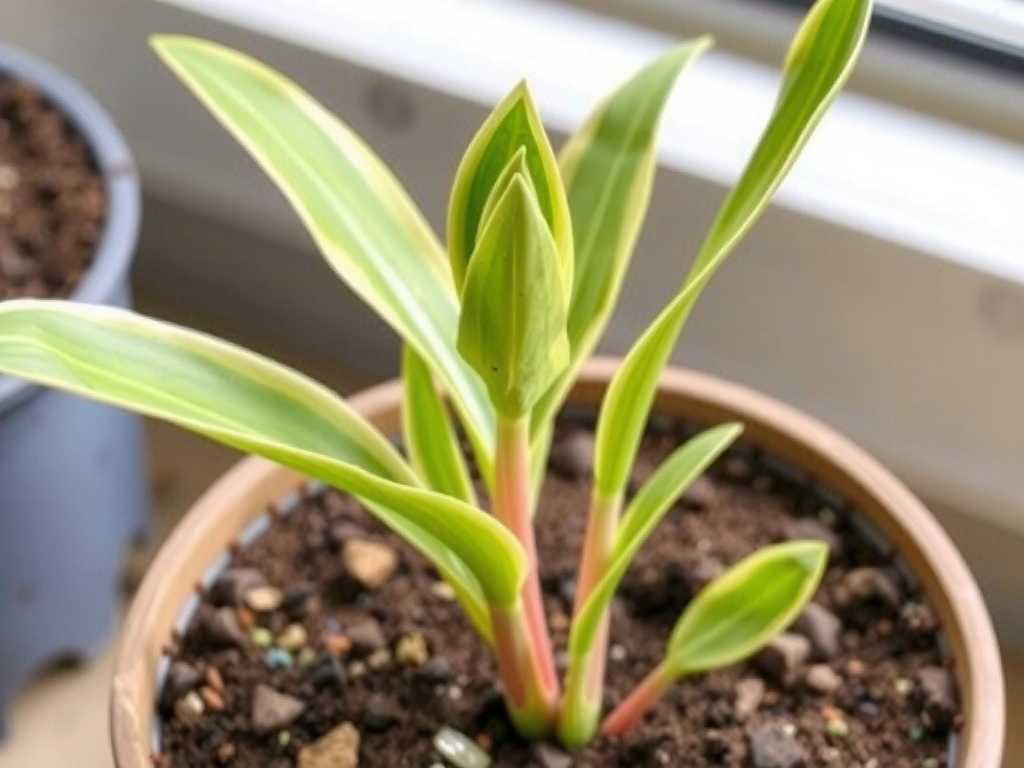
A snake plant cutting in soil is in a vulnerable, transitional state. Unlike a mature plant with a full root system, the cutting has limited or no roots to absorb water. Its primary focus is on developing new roots from the calloused end. Therefore, its water requirements are fundamentally different. The goal is to provide just enough moisture to encourage root growth without saturating the medium and causing the base to rot. The key principle is that the soil should be kept lightly moist during initial root development, transitioning to the classic “dry out completely” method once a root system is established.
Forget the Calendar: The Critical Factors Dictating Watering Frequency
Setting a rigid “water once a week” rule is a recipe for failure. Your watering frequency must adapt to several dynamic factors. Ignoring these is the main reason cuttings fail.
- Soil Composition and Drainage: This is non-negotiable. Your cutting must be planted in a well-draining, chunky soil mix. A standard potting soil amended with 50% perlite, coarse sand, or pumice is ideal. This mix allows water to flow through quickly, holding minimal moisture around the cutting base while still providing some humidity for root initiation. A dense, moisture-retentive soil will stay wet for too long.
- Pot Size and Material: Always use a pot with drainage holes. The pot should be only slightly larger than the circumference of the cutting itself. A pot that is too large holds excess soil, which retains water far away from the cutting’s reach, creating a perpetually damp environment. Terracotta pots are excellent for cuttings as they are porous, allowing the soil to dry from the sides as well as the top.
- Environmental Conditions (Light, Temperature, Humidity):
- Light: A cutting receiving several hours of bright, indirect light will theoretically use water (once roots form) and dry the soil faster than one in a low-light spot. However, avoid direct hot sun, which can scorch the cutting.
- Temperature & Humidity: Warm temperatures (70-85°F or 21-29°C) encourage faster root growth and evaporation. Cooler temperatures slow everything down, meaning the soil stays moist much longer. High ambient humidity reduces the need for frequent watering, while dry, arid air may cause the top soil to dry quicker.
The Step-by-Step Guide to Watering Snake Plant Cuttings
Follow this actionable framework to eliminate guesswork.
Phase 1: The Initial Planting and First Watering After planting your calloused cutting in your well-draining mix, give it a thorough initial watering. Water until it runs freely from the drainage holes. This settles the soil and ensures moisture is available. Then, place the pot in its designated bright, indirect light location.
Phase 2: The “Finger Test” Method – Your Primary Tool This is the most reliable technique. Insert your finger about 1-2 inches into the soil near the cutting.
- If the soil feels damp or cool: Do not water. Wait.
- If the soil feels completely dry: It’s time for a moderate drink. Water gently around the base of the cutting until the soil is lightly moistened throughout. You do not need to drench it as thoroughly as the first watering.
During the first 3-8 weeks, your goal is to prevent the soil from becoming bone dry for extended periods, which can desiccate the emerging root buds. Maintain that light moisture.
Phase 3: Recognizing Root Establishment and Shifting Strategy How do you know it’s working? Signs of successful root growth include:
- The cutting feels firmly anchored in the soil (gentle tug test).
- New, firm growth emerges from the center or base of the cutting.
- The cutting itself remains firm and upright, not mushy or wrinkled.
Once you see clear signs of establishment, you can begin to transition to the mature snake plant watering routine. Allow the soil to dry out completely between waterings. This encourages the roots to grow stronger as they seek out moisture.
Troubleshooting: Signs You’re Watering Incorrectly
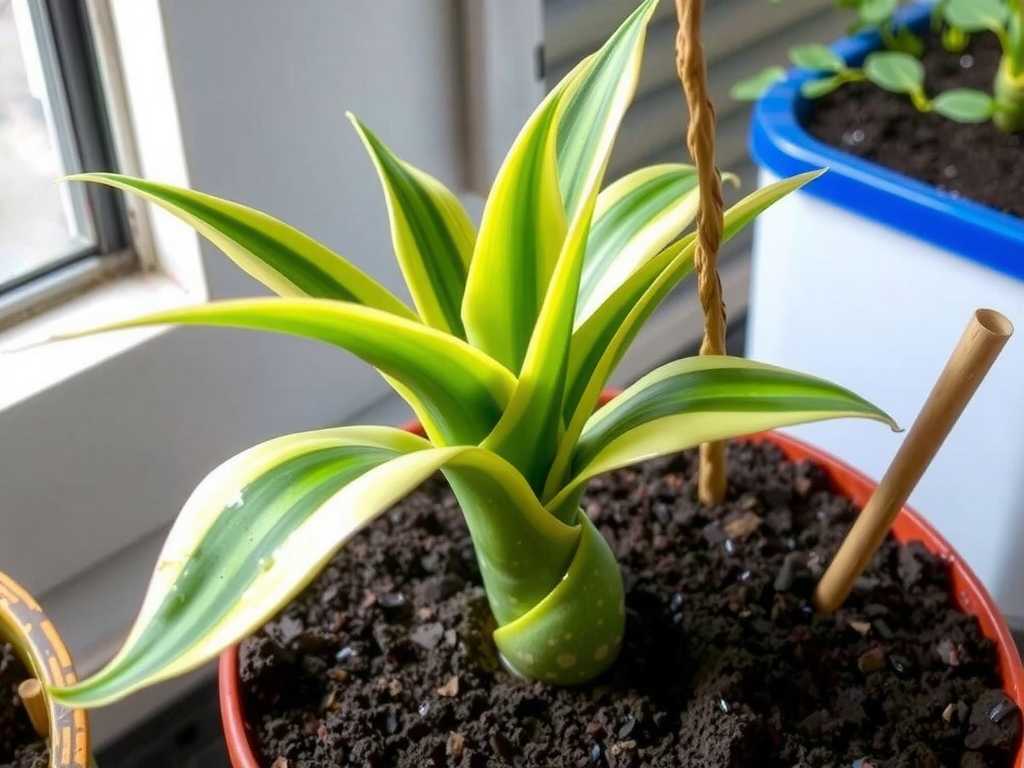
Learn to read your plant’s signals.
- Signs of Overwatering (Far More Common):
- The base of the cutting becomes soft, mushy, or discolored (yellow/brown).
- The leaves may develop water-soaked, soft spots.
- A foul odor may emanate from the soil, indicating rot.
- Action: Immediately stop watering. If the base is soft, you may need to unpot, cut away all rotted material, re-callous, and start over in fresh, dry mix.
- Signs of Underwatering:
- The leaves become excessively wrinkled, dry, and may curl.
- The soil pulls away from the edges of the pot.
- Growth is completely stalled and the cutting appears shriveled.
- Action: Give the cutting a thorough, deep watering. If the soil has become hydrophobic (repels water), soak the entire pot in a basin of water for 15-30 minutes to rehydrate the medium.
Expert Insight for Success
Horticulturist and author Jane Smith emphasizes the importance of patience: “A snake plant cutting is not idle; it’s investing its energy below the surface. Our job is to provide stable, supportive conditions, not to force growth with constant watering. Erring on the side of dryness is almost always safer.”
A study on succulent propagation in the Journal of Horticultural Science noted that slightly dry conditions often stimulate more robust and extensive root development compared to constantly moist environments, as the plant is prompted to search for resources.
My cutting hasn’t shown any growth in months. Am I doing something wrong? Not necessarily. Snake plants are notoriously slow, especially from cuttings. As long as the cutting is still firm and not rotting, it is likely still developing roots underground. Patience is key. Re-evaluate your light and temperature conditions to ensure they are optimal.
Can I use a moisture meter for my snake plant cutting? Yes, a moisture meter can be a helpful tool to remove guesswork, especially for beginners. Insert the probe near the root zone. Aim to keep the meter reading in the lower end of the “moist” range during the establishment phase, and let it dip into “dry” before watering once roots are established.
Is bottom watering better for snake plant cuttings? Bottom watering—where the pot soaks up water from a saucer—can be effective as it encourages roots to grow downward. For a cutting, ensure you don’t let it sit in water for more than 30 minutes. Discard any excess water. This method helps prevent overwatering if done sparingly.
Mastering the watering frequency for your soil-cultivated snake plant cuttings ultimately comes down to mindful observation and adapting to your specific environment. By prioritizing a well-draining soil mix, using the finger test to gauge moisture, and understanding the signs of both progress and distress, you create the ideal conditions for root development. Remember, these plants thrive on neglectful attention—provide what they need, then step back and let them work their slow, steady magic. Your reward will be a robust, drought-tolerant plant that grew from your careful stewardship.
发表评论